Negotiating Your Workload



LifeSkills Academy Blog
Check back often to find interesting information and updates.
Negotiating Your Workload
Blog Series Week 9 of 9 — Workplace Negotiation
Work rarely stays still.
A new assignment arrives. A deadline moves forward. A client adds a requirement. A teammate leaves. A project that looked straightforward suddenly isn’t.
Most professionals respond the same way: quietly rearrange the workload, stretch the hours, push something else aside, and keep going.
But there’s another option — one that protects not only your capacity, but the quality of the work, the health of the team and its success.
Healthy workload negotiation isn’t about resisting responsibility. It's about protecting the quality of the outcome.
Workload Is More Than a List of Tasks
In the workplace, workload is rarely about volume alone. It’s about alignment. Sustainable performance depends on:
- Priorities
- Deadlines
- Resources
- Responsibilities
- and Expectations lining up.
Change one, and several others may shift.
If Tuesday’s deadline becomes Monday’s, something else may need to move. If a project gains three new requirements, the original timeline may no longer fit. If an urgent assignment takes priority, yesterday’s priorities don’t disappear — they simply compete for space.
Noticing isn’t complaining. It’s professional awareness.
Noticing early gives your team more room to respond before a manageable adjustment becomes a crisis.
Bring the Impact Question Forward
Suppose your manager adds an important assignment to your workload.
You could simply say “Yes” and try to squeeze it in. Or you could respond:
“Absolutely. With this becoming a priority, I’m currently working toward Thursday’s deadline on the client report and Friday’s team deliverable. Which would you like me to adjust?”
You’ve done something essential.
You haven’t refused the work. You haven’t chosen which organizational priority should lose its place. And you haven’t waited until Thursday afternoon to announce that something won’t be finished.
You’ve brought the impact question forward while there is still time to make a thoughtful decision.

That is responsible participation — one of the most valuable workplace skills.
You Don't Need the Answer to Raise the Question
This becomes even more valuable on a team.
A project change may affect people differently. One teammate sees the scheduling issue. Another recognizes a customer concern. Someone else knows a needed resource isn't available.
You may not have the authority—or enough information—to determine what should happen next.
But you can say:
"This changes the time available for the next phase. Have we considered what that may affect?"
One respectful question can invite useful information into the room.
The goal isn't to question every decision or create endless rounds of what if? It is to recognize when something consequential has changed and contribute what you know so the people involved can make an informed choice.
Responsible participation adds clarity; it doesn't add noise.
Before raising a concern, consider:
- What changed?
- What might it affect?
- What useful information do I have?
- Who needs to know?
- Am I helping us move toward a decision?
You don't have to own the decision to contribute information that could improve it.
Another Question May Deserve Another Decision
Here's something easy to forget: the original plan may have been an excellent plan. It was created with the information available at the time. Then something changed.
Good teamwork doesn't require pretending that yesterday's decision still fits today's conditions. Nor does good leadership require defending a decision simply because it has already been made.
Leadership isn't demonstrated only by making decisions. Sometimes it is demonstrated by recognizing when another question deserves another decision.
That doesn't mean the plan must change. After considering the new information, the team or leader may decide the original course is still best. That's valuable, too. It is now a considered decision rather than an assumption.
The objective isn't to preserve the original plan at all costs.
The objective is to reach the intended finish line well.
From Workload Management to Professional Judgment
There's a significant difference between saying:
"I have too much work."
and asking:
"Something in our working equation has changed. What does that affect?"
The first may begin an important conversation about capacity.
The second demonstrates something more: awareness of how your work connects with the work and goals around you.
That perspective can grow at any level of an organization. You don't need a management title to think beyond your own assignment.
In fact, learning when to speak up, what information to bring and how to raise a concern respectfully may be one of the ways you become an increasingly valuable teammate.
Wisdom Counts the Cost
Scripture offers a practical picture of this kind of thinking:
“If you wanted to build a building, you would first sit down and decide how much it would cost. You must see if you have enough money to finish the job.”— Luke 14:28
The wisdom isn't merely in beginning the work. It's in considering what completing it will require.
When circumstances change, responsible stewardship may mean looking again at the cost—in time, resources, capacity, quality and people—and determining whether the original plan still works.
Sometimes wisdom says “continue.”
Sometimes it says “adjust.”
And sometimes it says, “We need another conversation before moving forward.”
What Others Learn From Watching Us
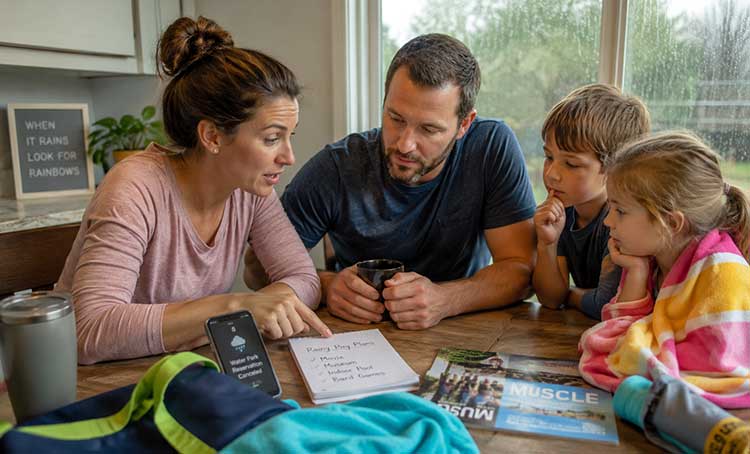
Young people—and our colleagues—notice how we respond when plans change.
Do we silently absorb every new expectation until frustration takes over? Do we resist change automatically? Or can we demonstrate another way?
"Something changed. Let's look at what that affects."
That models critical thinking without criticism, courage without confrontation, and flexibility without abandoning responsibility.
Those are skills that travel far beyond the workplace.
A Gentle Practice
The next time your workload or a shared project changes, pause before automatically rearranging everything yourself.
Ask:
- What changed—and what else might that change?
- Is what I see consequential enough to bring forward?
- Can I add clarity rather than noise?
- Is this a question that prolongs a decision—or one that may improve it?
Then communicate what matters while there is still time to use the information well.
Because healthy negotiation isn't about getting our way. It's about learning to recognize what matters, communicate it well, and participate responsibly in creating a workable way forward.
Your workload may be the arena. Responsible participation is the larger life skill.
This 3-week series on workplace negotiations has tips and strategies that can be employed, built on and aligned in your work practice. They form a steady workplace posture: clarity without confrontation, collaboration without losing ourselves, and professional judgment rooted in stewardship and peace. They are not just negotiation skills — these are habits that help us work wisely, lead respectfully, and contribute with purpose wherever we are. Your adventure into these tactics will reveal what works best for you. And we stand with you as you grow these skills and applaud your journey’s successes.
If you're interested in staying informed about LifeSkills Academy’s valuable life skills content and updates, we encourage you to sign up for our newsletters and class notices. Join us on the journey of continuous learning and personal growth. Together, let's build a foundation for success in life and our world.
Most Recent Posts ...

Posted on: 10/19/2026

Posted on: 10/12/2026

Posted on: 10/5/2026

Posted on: 9/28/2026
Search All Blog Posts
Blog Post Archive Categories
- You're Not Where You Were in January
- Teaching Financial Awareness to Children & Young Adults
- Transparency, Trust & Shared Responsibility
- Are You Covered for the Life You`re Actually Living?
- What Financial Advisors Actually Do
- You Are Not Meant to Figure Out Finances Alone
- Halloween Etiquette: Teaching Respect and Community Spirit
- Words of Wisdom: Traveling 2024
- Thankful Thursdays
- My interview with Dennis Pearce