What Should I Believe?



LifeSkills Academy Blog
Check back often to find interesting information and updates.
What Should I Believe?
Testing What You Hear — and What You Already Know
We have access to more information than most generations before us could have imagined.
Advice arrives from experts, friends, family, social media, podcasts, headlines, search results—and now AI. Some of it is excellent. Some is incomplete. Some is opinion presented with impressive confidence.
And then there is another source we don't always think to examine:
What we already believe.
Last week, we took inventory of what experience has taught us and recognized that we're not standing where we were in January.
But becoming more capable doesn't mean accepting everything we've learned—or everything we're told. It means becoming increasingly skillful at knowing what deserves our trust.
Start With Curiosity
Curiosity gives us another option. We can encounter an unfamiliar idea without immediately accepting or rejecting it.
- That's interesting. What supports it?
- Is there another way to look at this?
- What might I be missing?
- Does this fit with what I already know—or give me a reason to look again?
That turns new information into exploration rather than threat. Sometimes the adventure is discovering something entirely new. Sometimes it's discovering that something we thought we knew deserves another look.
Give Important Information Room to Prove Itself
Before information becomes part of an important decision, give it some room to prove itself.
Check the source.
Who is providing the information? What experience, evidence or expertise supports it?
Separate fact from interpretation.
What actually happened—and what is someone's interpretation of what happened?
Look for support.
Can the claim be verified elsewhere? Does other reliable information point in the same direction?
Notice what's missing.
Are you seeing enough of the picture to make a sound decision?
Discernment doesn't mean investigating every detail of daily life. The greater the consequence, the more worthwhile the examination.
Choosing a restaurant and choosing a life partner clearly carry different consequences. Accepting a new job, buying a home or making an important financial decision deserves more examination than deciding what to serve for dinner.
Discernment includes knowing when to look deeper.
Wisdom recognizes the difference.
Test Your Own Assumptions

This may require a little more courage.
We naturally question information that conflicts with what we believe. We're often less inclined to question information that agrees with us.
So occasionally turn the questions around:
- What am I assuming here?
- Am I working with current information—or an old conclusion?
- Have circumstances changed since I formed this opinion?
- What evidence might cause me to reconsider?
Discernment isn't only the ability to recognize weaknesses in someone else's thinking. It's also the willingness to examine our own.
What Did You Learn Early?
Some of our deepest assumptions arrived long before we knew they were assumptions.
We learned about money, work, relationships, responsibility, authority, success, failure, conflict—and even our own abilities—from the people and environments around us.
Much of that learning may contain remarkable wisdom worth keeping.
Some may need a new application for a different season of life.
Some may have been appropriate for circumstances that no longer exist.
And occasionally, something we accepted as a universal truth may turn out to have been one person's experience.
The goal isn't to discard what came before because it is old. Nor is it to preserve every application simply because it is familiar.
Test it. Find the wisdom inside it.
“Save for a rainy day” remains sound financial wisdom even though how we save—and the financial tools available to us—may change.
“Respect your elders” may grow from childhood obedience into adult respect that also knows how to ask thoughtful questions, disagree graciously and maintain healthy boundaries.
Don't confuse updating an application with abandoning a principle.
Sometimes maturity isn't replacing what we were taught. It's finally understanding the wisdom underneath it.
Test — And Keep the Good
The Apostle Paul, one of the early Christian teachers whose letters became part of the New Testament, gave remarkably concise advice to the Thessalonians:
“Test everything; hold fast what is good.” — 1 Thessalonians 5:21
Notice both parts: Test. And keep.
We're not told to automatically accept something because it sounds convincing—or reject it because it's unfamiliar.
Evidence matters. Experience matters. Trusted counsel matters. And God's wisdom provides a compass against which the rest can be examined.
The question becomes: Is this sound enough to build upon?
Give It a Field Test
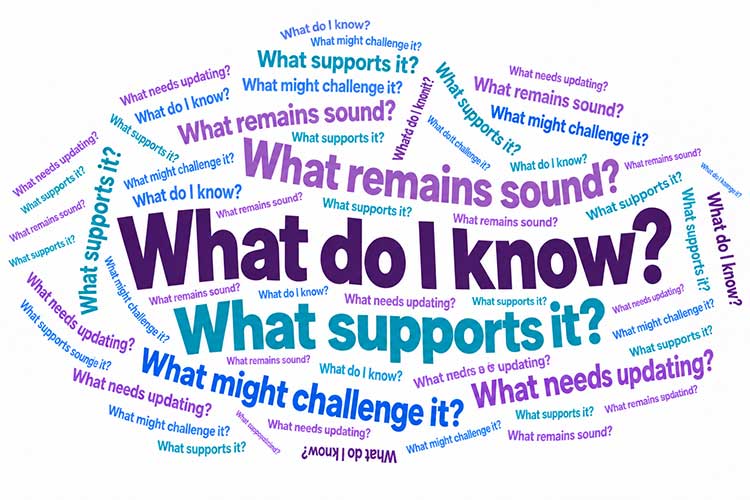
Choose one belief, assumption or piece of advice that currently matters to you. Not necessarily something controversial. Just something worth examining.
Ask:
- What do I know?
Separate what you can verify from what you're assuming. - What supports it?
Consider evidence, experience and trusted wisdom. - What might challenge it?
Be curious enough to consider another perspective. - What remains sound?
Keep it. - What needs updating?
Refine it.
Then take the soundest next step you can and pay attention to what happens.
You don't need perfect certainty before you move. You need enough sound information and wisdom to take a responsible next step—and enough humility to learn from the result.
A Rhythm Worth Remembering
There's a useful rhythm developing here:
NOTICE → TEST → ASSESS → REFINE → TRANSFER → LIVE
NOTICE what you're learning—and what you're carrying.
TEST whether it is sound.
ASSESS what experience reveals.
REFINE what needs adjustment.
TRANSFER what proves useful.
LIVE what proves wise.
You don't have to know everything. You can become increasingly skillful at knowing what to do with what you learn.
And discernment has an important place in that process.
Discernment isn't the finish line. It's what helps us choose what is worth carrying into the race.
Paul used that race imagery elsewhere in his writings, comparing purposeful living to an athlete who doesn't run aimlessly but knows what he is running toward.
We don't have to chase every voice from the sidelines. We can listen → Be curious → Test → Examine → Keep what proves sound → And then live it.
Because discovering something sound isn't the end of learning either.
“Honesty is the first chapter of the book of wisdom.” – Thomas Jefferson
Next week, we'll explore another question:
Once something proves useful, where else could it work?
We invite you to join our community of continuous learners. Sign up for newsletters and class notices to stay informed about valuable life skills. Together, let's build a foundation for success in our lives and our world.
Most Recent Posts ...

Posted on: 9/7/2026
Posted on: 8/31/2026

Posted on: 8/24/2026

Posted on: 8/17/2026
Search All Blog Posts
Blog Post Archive Categories
- You're Not Where You Were in January
- Teaching Financial Awareness to Children & Young Adults
- Transparency, Trust & Shared Responsibility
- What Should I Believe?
- Negotiating Your Workload
- Team Negotiation
- Halloween Etiquette: Teaching Respect and Community Spirit
- Words of Wisdom: Traveling 2024
- Thankful Thursdays
- My interview with Dennis Pearce