Boundary-Setting Skills Without Guilt or Pressure



LifeSkills Academy Blog
Check back often to find interesting information and updates.
Boundary-Setting Skills Without Guilt or Pressure
Written By: Sandi MacCalla, Founder - LifeSkills Academy ~ 1/19/2026
CLICK here for our Boundary Response Cheat Sheet
Winter has a way of piling things on quietly.
Invitations. Expectations. Requests. Along with internal voices that say:
- You should show up.
- You should push through.
- You should do this.
By midwinter, many of us aren’t just managing commitments — we’re negotiating with our own conscience, energy, and sense of responsibility.
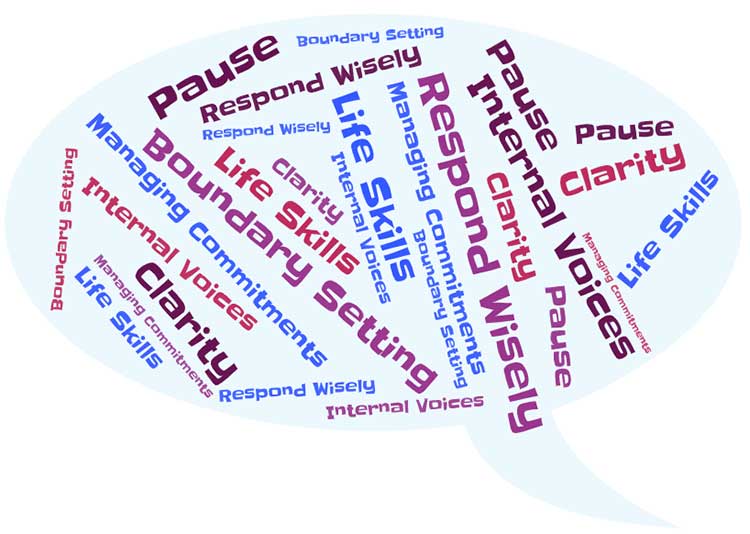
At LifeSkills Academy, we believe boundary-setting is not about becoming tougher or more distant. It’s about learning to respond wisely — to others and to ourselves.
That’s a life skill.
Boundary-Setting Is More Than “Just Saying No”
Boundary conversations are often reduced to a single word: “no.” But real life is more nuanced than that.
Sometimes:
- a full “yes” isn’t possible
- a full “no” isn’t necessary
- and what’s needed is clarity, honesty, and respect
Healthy boundaries don’t shut doors unnecessarily. They define the doorway — what can come in, what cannot, and what might be negotiated.
The First Boundary Is Often Internal
 Before responding to anyone else, most of us are already in conversation with ourselves.
- I should want to help.
- I’ve always said “yes” before.
- If I say “no,” I’ll disappoint someone.
These internal “shoulds” aren’t always wrong — but they’re not always wise either.
Life skill: Learning to pause before obeying every internal pressure.
Ask yourself:
- What is actually being asked of me?
- What do I realistically have to give right now?
- What would a mature, honest response look like — not a reactive one?
Clarity here prevents guilt later.
A Respectful Boundary Honors Both Parties
A well-set boundary does not shame the asker, and it does not sacrifice the responder.
It sounds like:
- honesty without over-explaining
- kindness without self-betrayal
- clarity without defensiveness
Examples:
- “I can’t commit to that fully, but I could help in this smaller way.”
- “This season is tighter for me than usual — thank you for understanding.”
- “I need to say ‘no’ to this right now, but I appreciate being asked.”
Notice what’s missing:
- apologies for having limits
- long justifications
- emotional pressure
Boundaries stated clearly and calmly are easier for others to respect.
When There Is Room for Negotiation
Not every boundary conversation needs to end the discussion.
Sometimes, both people benefit from:
- adjusting expectations
- changing timing
- scaling back the request
A skillful response might include:
- “What flexibility is there around this?”
- “If I couldn’t do all of it, what part would help most?”
- “Could we revisit this in a few weeks?”
 Negotiation is not a weakness.
It’s collaborative maturity.
Discipline and Inclination Don’t Have to Be Enemies
Many of us struggle when discipline says “push through” and our inner state says “I’d rather …”
Wisdom listens to both.
Discipline without discernment leads to burnout.
Inclination without discipline leads to avoidance.
Life skill: Learning to let discipline serve your well-being — not override it.
Winter is often a season for:
- conservation
- honesty
- smaller demands
- deeper rest
Responding accordingly is not failure.
It’s alignment.
A Simple Boundary-Setting Framework
Before responding, consider:
PAUSE – Don’t answer immediately
ASSESS – What is being asked? What do I have?
RESPOND – Clearly, kindly, and honestly
You don’t owe immediacy.
You owe integrity.
Resources
For anyone who would like to explore this further:
- Podcast on Presetting a Healthy Boundary: 'Life Kit': A therapist explains how to set practical boundaries | TPR
- Boundaries Updated and Expanded Edition: When to Say Yes, How to Say No To Take Control of Your Life: Cloud, Henry, Townsend, John: 9780310351801: Amazon.com: Books
Closing Encouragement
Boundaries are not walls.
They are guardrails — for others and for yourself.
When set with clarity and care, they:
- honor relationships
- protect energy
- build trust
- reduce resentment
And perhaps most importantly, they allow you to show up where you do say “yes” — fully present, without guilt.
That is a life skill worth mastering.
If you're interested in staying informed about LifeSkills Academy’s classes, valuable life skills content, and updates, we encourage you to sign up for our newsletters and class notices. Join us on the journey of continuous learning and personal growth. Together, let's build a foundation for success in life and our world.
Most Recent Posts ...
Posted on: 9/21/2026
Posted on: 9/14/2026

Posted on: 9/7/2026

Posted on: 8/31/2026
Search All Blog Posts
Blog Post Archive Categories
- You're Not Where You Were in January
- Teaching Financial Awareness to Children & Young Adults
- Transparency, Trust & Shared Responsibility
- Where Does This Belong?
- What Should I Believe?
- Negotiating Your Workload
- Halloween Etiquette: Teaching Respect and Community Spirit
- Words of Wisdom: Traveling 2024
- Thankful Thursdays
- My interview with Dennis Pearce